



Godkänn kakor
Vi använder oss av kakor (cookies) för att vår webbplats ska fungera bra för dig. De används även för webbanalys i syfte att hjälpa oss att förbättra våra tjänster.
Så använder vi cookies

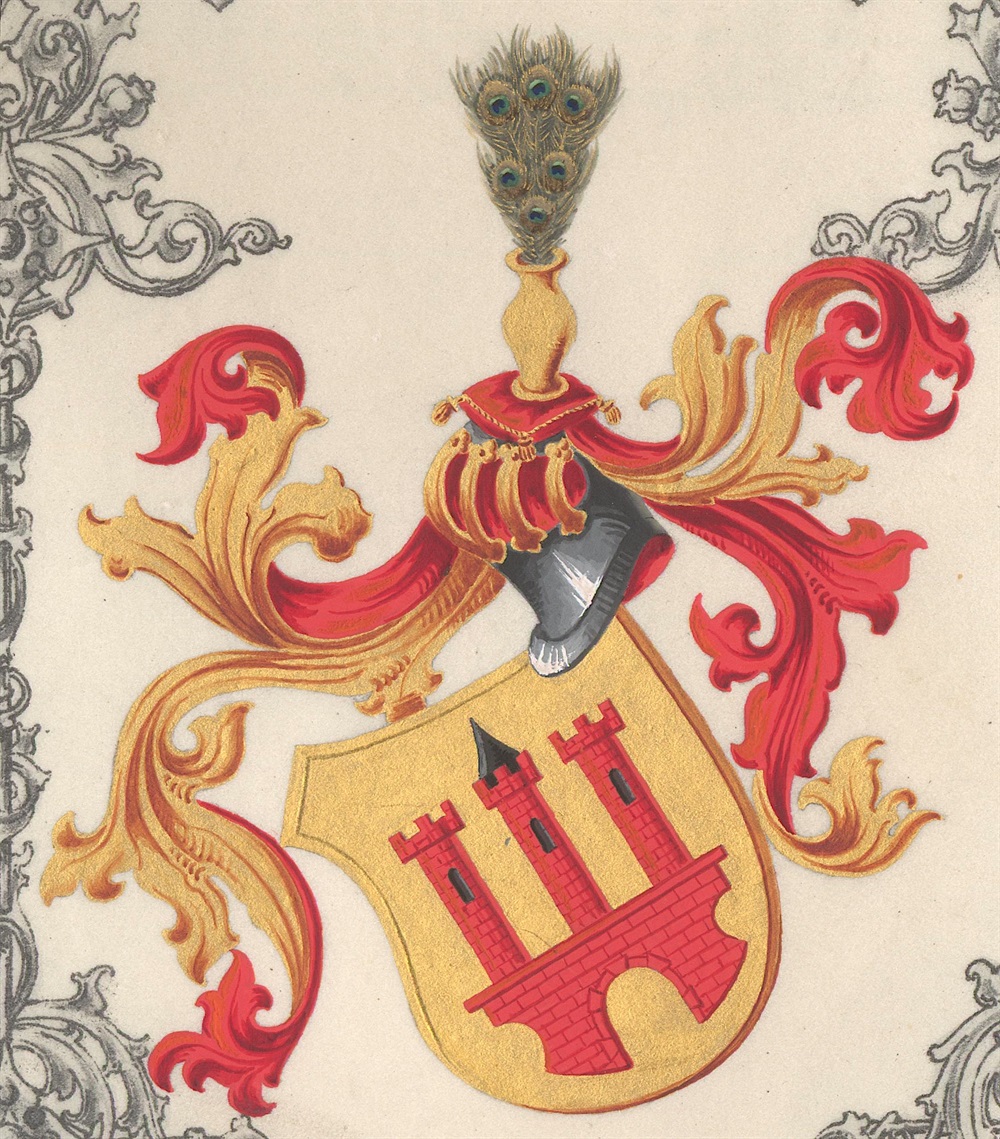 The von Euler-Chelpin family's coat of arms
Familjen von Euler-Chelpin, är en historisk tysk-schweizisk-svensk släkt med rötter runt Bodensjön framför allt i Lindau och senare Basel. Släkten har haft betydande inflytande inom vetenskap, såsom matematik, fysik, kemi, medicin samt teknologi, filosofi och konst från 1600-talet till idag.
Släkten är idag aktiv i flera länder och förvaltar ett levande kulturarv genom Släktföreningen von Euler-Chelpin, samt ett flertal biografiska och genealogiska publikationer.
Ursprung och namn
Den dokumenterade urfadern till de linjer som emigrerade från Lindau till Basel och tillbaka till Tyskland och därifrån till Ryssland och Sverige är Hans Georg Öwler (även kallad Schölpi) och som gifter sig 1555 med Katharina Schnell.
Släktnamnen Euler och Schölpi uppträder sammansatt och enskilt men för samma person i källor från 1300-talet i Lindauområdet. Binamnet “Schölpi” användes som ett beskrivande namn eller platsbeteckning för personer med familjenamnet Öwler (senare Euler). Chelpin är en senare stavningsform, troligen inspirerad av franska ljudförskjutningar.
Namnet von Euler-Chelpin etablerades officiellt 1884, då Karl von Euler-Chelpin och hans son Rigas togs upp i det bayerska adelsregistret. Rigas enda barn var sonen Hans Karl August Simon von Euler-Chelpin. Han emigrerade till Sverige och erhöll svenskt medborgarskap 1902 men avstod från introduktion till Riddarhuset. Hans von Euler-Chelpin är den Svenska grenens stamfader.
De Tyska grenarna börjar 1621 då Magister Samuel Euler lämnar Basel och blir pastor i Kurpfalz.
Den Ryska grenen etableras genom Leonhard Eulers emigration till St. Petersburg 1727
Vetenskapligt arv
Släktens vetenskapliga inflytande sträcker sig över 300 år, med flera generationer av framstående akademiker, inklusive fysiker, kemister, läkare, botanister och matematiker. Flera medlemmar har varit verksamma i Sverige, Tyskland, Schweiz och Ryssland och dokumenteras i släktens publikationer, däribland flera biografier, originalbrev och vetenskapliga verk. Släktens koppling till forskningsetik betonades bl.a. genom Hans von Eulers deltagande och etablering av Lindau Nobel Laureate Meetings, och medverkan till Mainau-deklarationen 1955. Släktens koppling till forskningsnätverk, universitet, akademier och inte minst genom Släktföreningen von Euler-Chelpin är pågående.
Vapen
1. Den Tysk-Svenska släktens vapensköld består av tre röda torn på gyllene sköld, med hjälmprydnad i form av påfågelfjädrar. Här ovan.
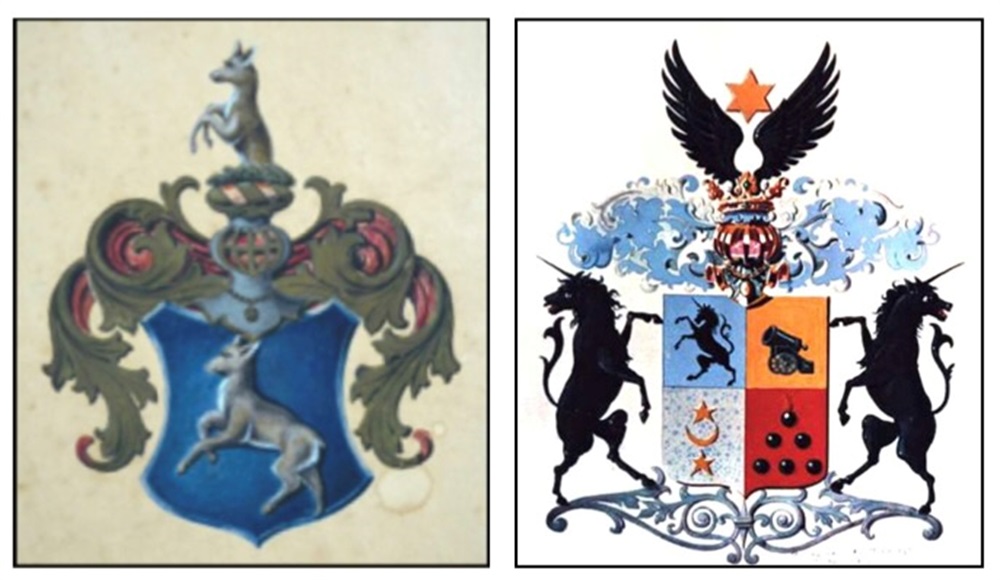
2. Det finns också exempel på en vapensköld som användes av den tyska Euler grenen - en hjort som hoppar från höger till vänster på blå bakgrund. Se här nedan.
3. Leonhards tre söner, Johann Albrecht, Karl och Christoph, är stamfader till de tre ryska linjerna.
Det råder ingen tvekan om att släkten Euler betraktades som adel. De hade sådana positioner och tillhörde de högsta adelsskikten. Johann Albrecht var statsråd, professor i fysik och ständig konferenssekreterare vid Rysslands högsta vetenskapliga institution. Karl var kollegierråd, hovläkare och tsarens personliga läkare. Christoph var generallöjtnant med titeln Excellens.
Dessa tre positioner var säkerligen kopplade till adeln, som sedan förblev inom familjen. Detta förklarar också varför ättlingarnas äktenskap nästan alltid ingicks med representanter för den ryska adeln; fyra gånger finns det till och med äktenskap mellan Leonhards ättlingar som ingicks med medlemmar av ryska furstliga familjer.
Beträffande Leonhard själv övervägdes frågan om en hög titel under hans andra kallelse till Petersburg. Kejsarinnan Katharina Il avstod dock från att göra det med den goda anledningen att en sådan titel skulle placera Leonhard "på samma nivå som ett antal personer som inte är värdiga honom; hans berömmelse är bättre än någon titel". Denna anmärkning förädlar den ryska linjens ledare mer än någon titel skulle kunna göra.
Vi har funnit exempel på att den Ryska Euler grenen var representerad av en vapensköld med en hoppande enhörning. Se här nedan till höger.
..........................................................................................................................................................
The von Euler-Chelpin family is a historical German-Swiss-Swedish family with roots around Lake Constance, especially in Lindau and later Basel. The family has had a significant influence in science, such as mathematics, physics, chemistry, medicine as well as technology, philosophy and art from the 17th century to the present day.
The family is today active in several countries and manages a living cultural heritage through the von Euler-Chelpin Family Association, as well as several biographical and genealogical publications.
Origin and name
The documented ancestor of the lines that emigrated from Lindau to Basel and back to Germany and from there to Russia and Sweden is Hans Georg Öwler (also called Schölpi) and who married Katharina Schnell in 1555.
The family names Euler and Schölpi appear together and separately but for the same person in sources from the 14th century in the Lindau area. The byname “Schölpi” was used as a descriptive name or place name for people with the family name Öwler (later Euler). Chelpin is a later spelling, probably inspired by French sound shifts.
The name von Euler-Chelpin was officially established in 1884, when Karl von Euler-Chelpin and his son Rigas were entered in the Bavarian nobility register. Rigas' only child was his son Hans Karl August Simon von Euler-Chelpin. He emigrated to Sweden and received Swedish citizenship in 1902 but declined induction into the House of Knights. Hans von Euler-Chelpin is the ancestor of the Swedish branch.
The German branches begin in 1621 when Magister Samuel Euler leaves Basel and becomes a pastor in the Kurpfalz.
The Russian branch is established by Leonhard Euler's emigration to St. Petersburg 1727
Scientific heritage
The scientific influence of the family extends over 300 years, with several generations of prominent academics, including physicists, chemists, physicians, botanists and mathematicians. Several members have been active in Sweden, Germany, Switzerland and Russia and are documented in the family's publications, including several biographies, original letters and scientific works. The family's connection to research ethics was emphasized, among other things, through Hans von Euler's participation and establishment of the Lindau Nobel Laureate Meetings, and participation in the Mainau Declaration in 1955. The family's connection to research networks, universities, academies and not least through the von Euler-Chelpin Family Association is ongoing.
Cote of Arms
1. The coat of arms of the German-Swedish family consists of three red towers on a golden shield, with a helmet ornament in the form of peacock feathers. Here above. 2. There is also an example of a coat of arms used by the German Euler branch - a stag jumping from right to left on a blue background. See here below. 3. Leonhard's three sons, Johann Albrecht, Karl and Christoph, are the ancestors of the three Russian lines. There is no doubt that the Euler family was considered noble. They held such positions and belonged to the highest nobility. Johann Albrecht was a state councilor, professor of physics and permanent conference secretary at the highest scientific institution of Russia. Karl was a collegiate councilor, court physician and the Tsar's personal physician. Christoph was a lieutenant general with the title of Excellens. These three positions were certainly connected to the nobility, which then remained within the family. This also explains why the descendants' marriages were almost always concluded with representatives of the Russian nobility; four times there are even marriages between Leonhard's descendants concluded with members of Russian princely families. As for Leonhard himself, the question of a high title was considered during his second summons to Petersburg. However, Empress Catherine II refrained from doing so with the good reason that such a title would place Leonhard "on the same level as a number of people who are not worthy of him; his fame is better than any title". This remark ennobles the leader of the Russian line more than any title could do. We have found examples of the Russian Euler branch being represented by a coat of arms with a leaping unicorn. See below on the right.
Vi använder oss av kakor (cookies) för att vår webbplats ska fungera bra för dig. De används även för webbanalys i syfte att hjälpa oss att förbättra våra tjänster.
Så använder vi cookies